
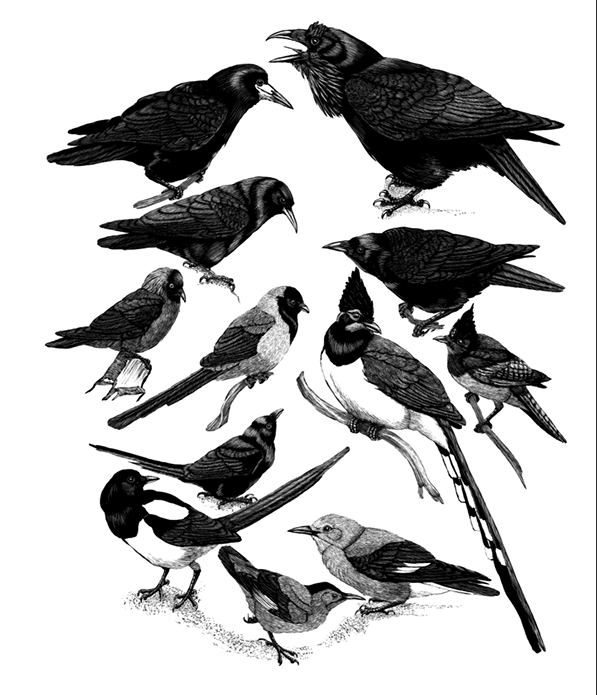
Sociobiology of Corvidaceae
Corvids are a family of birds that include crows, ravens, rooks, jackdaws, jays, magpies, and others. There are over 120 species of corvids worldwide, making them one of the most widespread and successful bird families.
They are medium to large-sized birds, ranging from 11 inches to 2 feet in length, having stout and strong bills, which are slightly curved and shaped for omnivorous diets. Their feathers are iridescent black, brown, gray, or blue in coloration.
Corvids are incredibly intelligent compared to other bird species. Their brains have a large forebrain where higher-order thinking occurs. They have excellent eyesight and observational skills to spot food sources. Many corvids are highly social and live in family groups that work together to find food, defend territories, and rear young.
Corvids are renowned for their exceptional cognitive abilities, including tool use, problem-solving, and complex social behaviors. Studies have shown that species such as ravens and crows are capable of advanced problem-solving tasks, tool manipulation, and even symbolic communication, rivaling the cognitive abilities of some primates.
Corvids have the largest brain size relative to their body weight of any bird species. Their brains have developed large frontal lobes and expanded memory capacity, allowing for problem-solving, tool use, and social intelligence similar to great apes and dolphins.
[Open linked file for full presentation]