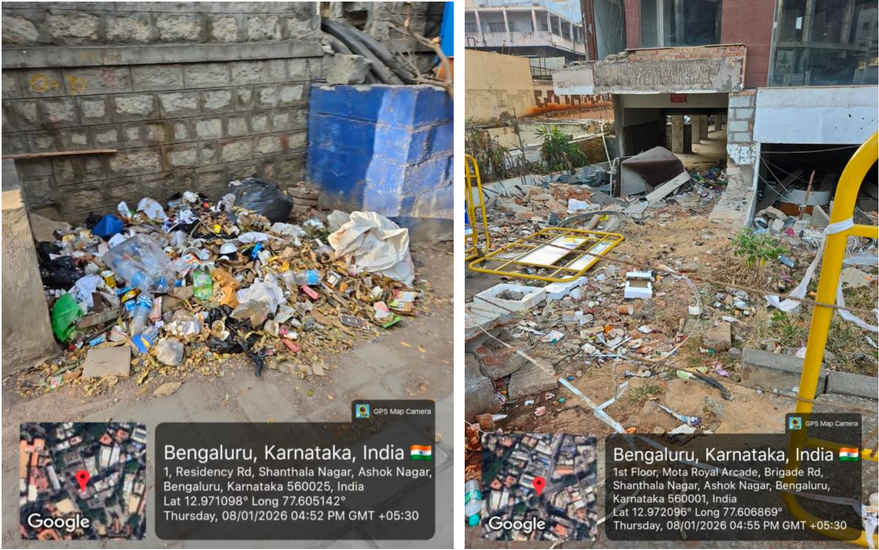

Bioremediation of Municipal Solid Waste Pollution in Open Dumps
Land pollution refers to the degradation of soil and land resources due to the accumulation of solid and liquid wastes, chemicals, and other pollutants from human activities such as industrialization, agriculture, and urbanization. This form of pollution adversely affects soil quality, ecosystem functioning, and human
health. It commonly manifests through open dumping, overflowing landfills, littering, plastic contamination, hazardous waste disposal, and poorly planned urban settlements, all of which reduce land usability and ecological resilience.
Urban land pollution, primarily in the form of Municipal Solid Waste (MSW), consists largely of biodegradable organic matter and inert materials, with a smaller yet environmentally significant fraction of non-biodegradable and hazardous components. In typical Indian and other low- to middle-income urban settings, MSW composition is approximately 30–55% biodegradable organic waste (food scraps, garden waste), 40–55% inert materials (dust, ash, construction debris), and 5–20% recyclable materials such as plastics, paper, metals, and glass. Among these, plastics constitute around 7–18% of total waste (Carry bags, packaging films, multilayer sachets, bottles, containers) and are particularly persistent in open dumps due to their low biodegradability. In Bengaluru alone, BBMP's latest public data shows a daily MSW generation of 3000–3500 tones, with organic wastes as the dominating portion (~45%), followed by plastics and glassware (~38%) and then electronic and biomedical waste (~2%), and inert materials.
Although hazardous waste forms a relatively small proportion of household waste by mass (generally below 1–3%), it poses disproportionately high risks due to the presence of toxic chemicals and heavy metals. Common domestic hazardous wastes include paints, solvents, pesticides, waste oils, batteries, mercury-containing lamps, cleaning chemicals, and expired pharmaceuticals. Improper disposal of these materials significantly increases the toxicity of landfill leachates and surrounding environments.
The current waste management crisis arises because the volume of waste generated, especially plastics and non‑biodegradable materials, is growing faster than the capacity of collection, recycling, and safe disposal systems. Only a small fraction of total waste is effectively recycled, while the rest is landfilled, burned, or mismanaged, leading to long‑term soil contamination, greenhouse gas emissions, and leakage of trash into rivers and oceans, where it further increases the environmental and health risks. It is estimated that more than 60% of MSW is often disposed of in open dump sites and is subject to natural degradation on vacant lands. These disposal sites lack efficient waste processing systems and the natural
degradation of dumped MSW along with formation of methane and toxic soil leachates pose serious environmental and health risks.
One of the most common problems associated with waste materials in urban areas is the inefficiency of waste collection, disposal, and recycling systems, which results in a significant proportion of waste being dumped in open areas, roadside sites, and landfills, where it often remains for extended periods of time. This has various harmful implications, including environmental degradation, public health risks, soil and water contamination, and the proliferation of disease-carrying pests.
Toxic leachates percolating through waste materials carry contaminants like heavy metals, pathogens, and organics that contaminate soil, groundwater, and surface water.
Leachate infiltration in groundwater, causes contamination and increase in BOD, rendering the water unsafe for use.
Surface water runoffs may enter into lakes/streams and also enter into the soil, impacting ecosystems in the surrounding.
Waste dumps degrade soil pH, microbial diversity, and fertility via heavy metal accumulation and organic pollutants.
Landfill gas (methane, CO₂, H₂S) and fires emit greenhouse gases, foul odors, and toxins causing global warming and respiratory issues.
Open dumps breed disease vectors (flies, mosquitoes, rodents) facilitating the spread of infections including dengue, malaria, and gastrointestinal diseases. Chronic exposure to toxic substances from waste sites has been linked to skin irritation, eye problems, fatigue, and increased cancer risks.
Inorganic pollutants mostly include the potentially toxic elements, like mercury (Hg), lead (Pb), and cadmium (Cd), which are considered one of the most important environmental pollutants, mainly due to their non-degradability, high persistence, and toxicity, even in trace amounts. Their accumulation in soils and food chains poses long-term risks to environmental and human health.
Though biodegradable, organic waste materials such as food scraps, garden waste, dung, and other organic residues may take a long time to naturally decompose, especially in urban environments where temperature, moisture, aeration, and microbial diversity are not optimal.
Prolonged accumulation of such waste over days or weeks can result in foul odours, leachate generation, and the breeding of disease-causing vectors such as flies and rodents, posing serious environmental and public health concerns.
Targeted Bioremediation Strategies for Waste Management
Biotechnological approaches enable sustainable and accelerated decomposition of solid waste through controlled microbial and enzymatic processes, enhancing environmental safety and improving the safety and stability of areas surrounding dump sites.
AEROBIC COMPOSTING WITH TAILORED MICROBIAL INOCULUM FOR THE BIODEGRADABLE FRACTION
The decomposition of the biodegradable solid organic waste material under the action of microorganisms in warm and moist conditions is referred to as composting. Humus, produced as a byproduct of composting enhances the physical, chemical and biological properties of the soil. Microorganisms like
Streptomyces rectus, Thermomonospora fusca, Thermopolyspora bispora, Thermoactinomyces sp., Bacillus subtilis and Pseudomonas fluorescens, etc. are used for microbial decomposition.
For source‑segregated or manually segregated wet waste near dumps, aerobic composting is a primary option. For roadside situations, small modular composting units or windrows at ward-level transfer stations are typically used rather than directly on the road edge. Aerobic composting with microbial inoculants outperforms physical and chemical methods like landfilling or incineration, by naturally accelerating decomposition, producing nutrient-rich compost, and minimizing emissions without high energy inputs or residues. It handles organic MSW fractions effectively while avoiding the drawbacks of incineration or landfilling.
Aerobic composting maintains oxygen levels to favor beneficial microbes, drastically cutting methane emission drastically as compared to anaerobic landfilling.
Microbial inoculants enhance maturity, suppress pathogens and odors, and reduce nitrogen loss compared to chemical stabilizers that risk soil pH imbalance.
Unlike NO/dioxin emissions from incineration or toxic residues from chemical treatment, composting leads to humus production, which is more beneficial for the surrounding.
Inoculants shorten composting time up to 30-50%
Low-tech setup suits urban dumps, avoiding chemical method's reagent/supply chain costs, shorter composting time also avoids land and labour costs as compared to incineration or chemical treatment setups.
Covering exposed organic waste with thin compost or soil‑compost mixes reduces odour and vectors, while initiating aerobic microbial activity. Further application of tailored microbial consortia, in the form of sprays or slurries, onto dump sites enhances the rate of biodegradation and reduces BOD/COD of leachates.
PLASTIC DEGRADATION USING MICROBIAL ENZYMES
Plastics are persistent pollutants that can remain in the natural environment for hundreds of years or longer if not properly disposed of or recycled. In large dumpsites or roadside open dumps, plastic waste, especially small items such as wrappers, often persists for extended periods. It is estimated that only 10%
of plastic waste is recycled, 14% is incinerated, and the rest is dumped into landfills, ultimately entering the natural environment.
Plastics are made up of numerous compounds including basic substances, such as monomers, oligomers, polymers, and additives, and the additives mainly divided into plasticizers, antioxidants, heat stabilizers, and pigments. Apart from the pristine additives, plastics adsorb chemical pollutants from the surrounding environment, which makes plastics a hub for toxic substances.
Biotechnological plastic degradation uses microbes and enzymes to break down recalcitrant polymers like polyethylene, PET, and polystyrene into simpler compounds, offering a sustainable alternative for waste dumps. Bacteria and fungi isolated from plastic-polluted sites excel at this, often forming biofilms to access polymer surfaces.
Microbiological degradation of plastics is generally a process of breaking down the polymer into shorter chains or smaller molecules, depolymerized into monomers that may be necessary for microbial uptake and growth to pass through
semipermeable membranes and eventually mineralization in cells. The monomers in the cells are either mineralized into carbon dioxide, water, and methane (under anaerobic conditions) to produce biomass for energy.Microbial degradation occurs in stages: bio-adhesion, bio-deterioration, bio-fragmentation, and mineralization. Enzymes (cutinases, lipases, PETases) adsorb onto plastic, hydrolyzing ester or ether bonds via oxidation or hydrolysis. Hydrolysis products include CO₂, H₂O, oligomers, or monomers that microbes metabolize as carbon sources.
Bacteria and fungi play a dominant role in plastic biodegradation, with microbial consortia generally outperforming single strains. For polyethylene, species such as Pseudomonas aeruginosa, Microbacterium paraoxydans, and Bacillus spp. demonstrate degradation efficiencies ranging from 17-61% within 40–60 days. Polyethylene terephthalate (PET) is effectively degraded by microbes including
Ideonella sakaiensis and Bacillus cereus, with 10–58% degradation in ~42 days. For polypropylene, strains such as Pseudomonas aeruginosa WGH-6 and Aneurinibacillus spp. have shown 17–44% degradation over 40–140 days. Polystyrene degradation is reported with Pseudomonas aeruginosa DSM 50071 and Bacillus paralicheniformis, resulting in up to 34% weight loss. Bioplastics such as polylactic acid (PLA) are readily degraded, with microorganisms like Saccharothrix waywayandensis and Tritirachium album achieving 76–95% degradation within 7–14 days. Additionally, fungal species such as Aspergillus niger and Alternaria alternata have been shown to effectively degrade PE and PET, highlighting the potential of microbial and enzymatic systems for plastic waste remediation.
Biotechnological plastic degradation excels over conventional methods like incineration, landfilling, or mechanical recycling by being eco-friendly, cost-effective, and capable of true mineralization without harmful byproducts.
Microbial/enzymatic breakdown avoids dioxins, NO, and CO₂ emissions from incineration(up to 1.5 tonnes CO₂ per tonne plastic) while preventing landfill methane from plastics.
Produces biomass/CO₂/H₂O via mineralization, enriching soil microbes rather than depleting resources.
Low infrastructure needs (bioaugmentation sprays vs. expensive incinerators) cut costs by 50–80% for dump-scale deployment. It is also scalable on-site for mixed MSW.
PHYTO- AND RHIZOREMEDIATION AT DUMP MARGINS
Phyto- and rhizoremediation use plants and their root-associated microbes to stabilize and detoxify dump margins, preventing contaminant spread while restoring vegetation cover. It is a low maintenance and low cost solution to suit roadside/open dumps by creating green buffers that reduce erosion, leachate
migration, and visual blight.
Certain plant species are capable of direct management of pollutants by:-
Phytoextraction: Hyper accumulators (e.g., Brassica juncea) uptake heavy metals (Pb, Cd, Zn) into harvestable biomass. This is especially useful at landfills and construction sites, with higher levels of heavy metal leaching.
Phytostabilization: Roots bind metals/organics in soil, reducing bioavailability and leaching (e.g., Vetiver grass).
Phytodegradation: Enzymes in plants break down organics like hydrocarbons from waste leachate.
Hydraulic control: Deep-rooted phreatophytes pump leachate, blocking groundwater contamination. Root exudates from plants (sugars, acids, enzymes) stimulate pollutant-degrading microbes in the rhizosphere, further enhancing the effect.
Pseudomonas/Bacillus consortia degrade plastics, PAHs, and pesticides 2–10x faster near roots.
Mycorrhizal fungi extend metal sequestration via glomalin binding.
Combined plant-microbe systems achieve 50–80% contaminant reduction vs. plants alone.
Implementation at dump margins begins with site preparation, in which the margins are amended with compost or lime to raise soil pH, followed by seeding or planting vegetative buffer zones approximately 5–10 m wide. Microbial activity can be enhanced by inoculating plant roots with site-isolated microbial
consortia during transplanting, thereby improving degradation and stabilization processes. Ongoing maintenance involves initial irrigation to support plant establishment and the periodic harvesting of hyperaccumulator species to ensure safe disposal of accumulated contaminants. Integration with composting systems further supplies mulch, helping to create self-sustaining green belts around
dumpsites.
The increasing accumulation of municipal solid waste and persistent pollutants such as plastics in open dumps presents serious environmental and public health challenges, especially in rapidly urbanizing cities like Bengaluru. Conventional waste management methods alone are insufficient to address the scale and long-term impacts of mismanaged waste. Biotechnological approaches therefore offer a sustainable, scalable, cost-effective, and environmentally friendly alternative for mitigating land pollution and restoring degraded dump sites. The use of microbial composting for biodegradable waste, microbial and enzymatic plastic degradation, and phyto- and rhizoremediation at dump margins provides an integratedstrategy for waste stabilization and pollutant reduction. These methods accelerate decomposition, reduce leachate and greenhouse gas emissions, improve soil quality, and enhance biodiversity, while requiring minimal infrastructure and maintenance. Overall, biotechnological remediation presents a practical and scalable solution for managing open dumps. When supported by proper waste segregation, policy measures, and community involvement, these nature-based strategies can significantly reduce environmental risks and contribute to healthier and more resilient urban ecosystems.